Williams, Odunze Lift Bears Over Lions 39–35
Williams, Odunze Lift Bears Over Lions 39–35
The Chicago Bears defeated the Detroit Lions 39–35 in a dramatic Thanksgiving matchup after Caleb Williams found Rome Odunze for the winning touchdown with three seconds remaining.
The four-point victory came down to Chicago’s final possession. Trailing by four, the Bears needed a touchdown rather than a field goal. Williams delivered the decisive pass, and Odunze completed the play to give Chicago the lead before Detroit could respond.
Chicago Bears 39, Detroit Lions 35
The game produced 74 combined points in an offensive shootout. Detroit scored 35 points, but Chicago’s 39-point total proved decisive because the Bears produced the final score.
The Lions held the advantage before Chicago’s closing drive, but Williams and Odunze executed when the margin for error had disappeared. The result gave the Bears a memorable divisional win and left Detroit with almost no time to answer.
The Three-Second Winning Play
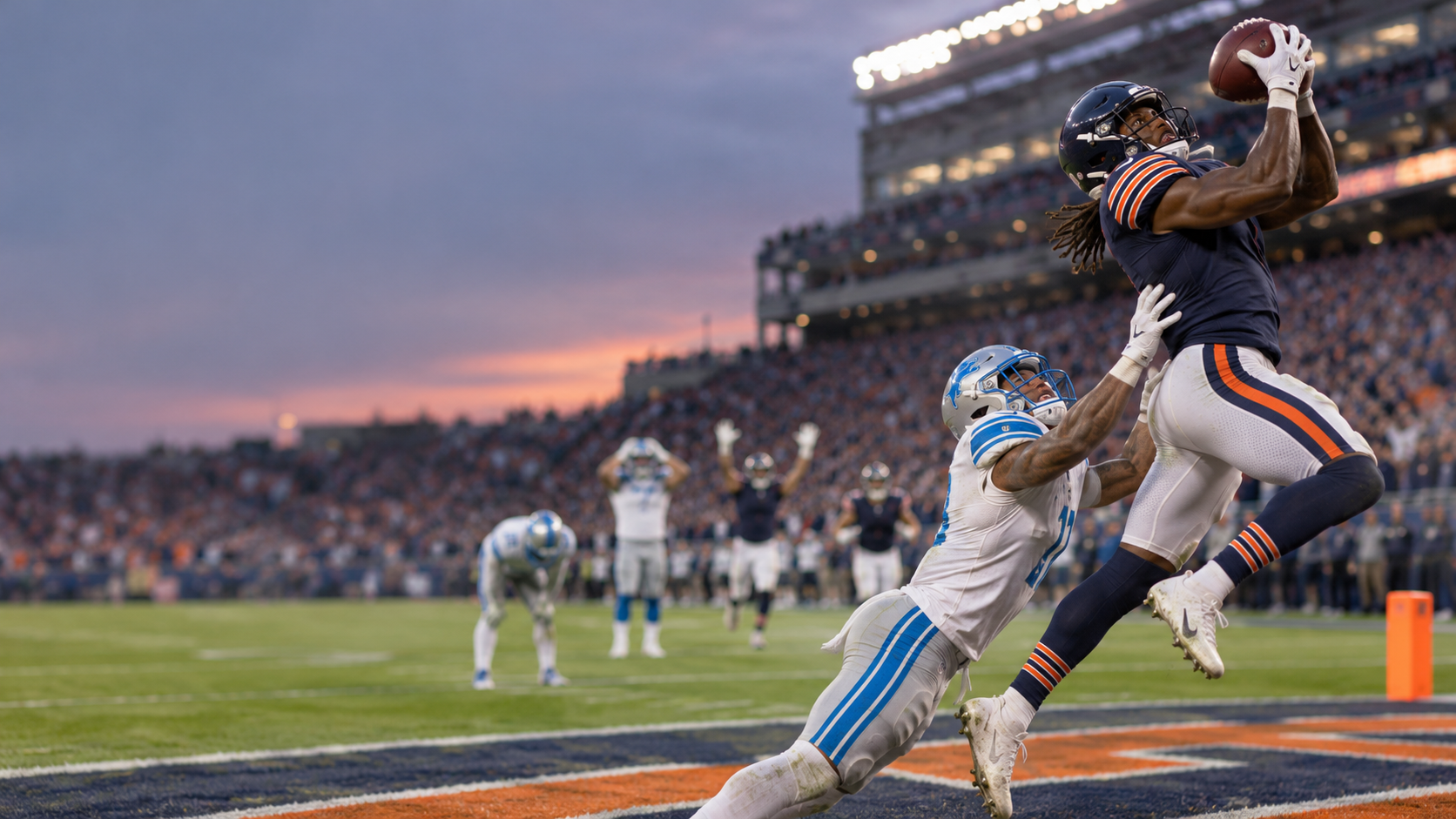
With three seconds remaining, Williams threw the touchdown pass that lifted Chicago over Detroit. Odunze caught the ball for the winning score, turning a late deficit into a 39–35 victory.
The timing made the play especially significant. Chicago could not settle for a field goal while trailing by four, so the offense had to reach the end zone. Williams supplied the necessary throw, and Odunze finished the possession.
The arithmetic shaped the play call. A field goal would have cut the deficit without changing who led, so the only route to a win ran through the end zone. That constraint removed the usual choices from Chicago’s decision-making: no clock-management trade-off between kicking and scoring, no option to take points and defend. Detroit knew a touchdown was required, and the Bears produced it anyway. Source 5
Detroit had virtually no opportunity to respond after the touchdown. The play therefore served as both Chicago’s winning score and the effective conclusion of the game. Source 1
Williams Delivers Under Pressure
Williams’ role in the victory centered on the final possession. The Bears needed an immediate touchdown, and the young quarterback produced the throw that changed the outcome.
The confirmed sequence is straightforward: Williams threw the touchdown, Odunze caught it, and three seconds remained. The play demonstrated execution in a high-leverage moment without requiring assumptions about the full drive, individual yardage, or route design.
One game does not provide a complete evaluation of Williams, but a last-second touchdown in a nationally visible Thanksgiving matchup gives Chicago a performance it can build around.
Odunze Makes the Winning Catch
Odunze completed the play that determined the game. Williams provided the throw, and the receiver finished the possession with the winning touchdown.
A Chicago Tribune report highlighted Odunze’s “clean toes” on the catch. Source 9 The detail added to the drama of a touchdown catch requiring precise body control and positioning.
The phrase isolates footwork, the part of a contested catch that decides whether the play counts. Route running and speed get a receiver to the ball; body control at the catch point converts the opportunity into six points. That skill is what the Tribune detail singles out, and it is the skill the final score depended on.
The larger takeaway is the connection between Williams and Odunze. Together, they produced the score Chicago needed at the exact moment the game demanded it.
Why the Bears’ Win Stands Out
A Comeback With No Margin for Error
Chicago faced a four-point deficit and a shrinking clock. An incompletion, mistake, or failure to reach the end zone would have preserved Detroit’s lead. Instead, the Bears executed the decisive play before time expired. Source 5
A 74-Point Shootout
The 39–35 score produced 74 combined points. Detroit’s 35 points would have been enough to win many games, but Chicago needed 39 to secure the result.
The scoring totals also explain why the final touchdown carried so much weight. Neither team built an insurmountable lead, and the game came down to which offense could produce the final decisive play.
A 74-point game with a four-point margin means the defense on neither side controlled the game for long. When both offenses score at that rate, the outcome usually falls to whoever holds the ball last with a chance to take the lead. Chicago held it last and converted.
The Thanksgiving Stage
Thanksgiving games receive significant national attention, making a dramatic finish especially memorable. NBC 5 Chicago described the result as a stunning Thanksgiving victory for Williams and the Bears. Source 7
What the Win Means for Chicago
The victory confirmed Williams’ ability to produce a decisive late touchdown pass and showed the potential value of his connection with Odunze.
Chicago can use the performance as evidence of late-game confidence, but a long-term evaluation must include consistency, efficiency, red-zone production, and results against different defensive approaches. One play establishes an important moment; repeated performances will determine whether the connection becomes a sustained feature of the offense.
For evaluation purposes, the final play should be treated as one data point among many. It answers a narrow question — can Williams and Odunze convert when the game requires a touchdown and the defense expects one — and leaves the broader questions open. Coaches can review the snap for execution details while resisting conclusions the single play cannot support.
The Bears also created a defining team moment. They did not wait for Detroit to make a mistake or protect a narrow lead. They had to create the winning score, and they did so before the clock reached zero.
What the Loss Means for Detroit
The Lions lost after Chicago scored with three seconds remaining. The narrow margin makes the defeat especially difficult because Detroit was within moments of securing the game.
Detroit must review the final sequence using film, official play-by-play information, and postgame comments. The loss does not by itself prove a systemic defensive problem, but it creates a clear area for examination. Detroit also must respond after scoring 35 points and still falling short.
The review should separate the final snap from the rest of the game. If the same coverage and pressure calls held up earlier, the last play is an execution failure; if the pattern repeats across the film, it is a structural issue. Sources listed here do not establish which applies.
Key Takeaways
- Caleb Williams made the defining throw: His touchdown pass with three seconds remaining determined the result.
- Rome Odunze finished the opportunity: His catch gave Chicago the lead and ended Detroit’s chance to respond.
- Chicago executed under pressure: The Bears needed a touchdown, not merely a scoring opportunity.
- Detroit lost despite scoring 35 points: Chicago’s 39 points, including the final touchdown, proved decisive.
- Thanksgiving magnified the finish: The holiday stage gave the last-second play national significance.
Frequently Asked Questions
Who threw the game-winning touchdown for the Bears?
Caleb Williams threw the game-winning touchdown pass with three seconds remaining.
Who caught the winning touchdown pass?
Rome Odunze caught Williams’ decisive touchdown pass.
What was the final score?
The Chicago Bears defeated the Detroit Lions 39–35.
How much time remained when Chicago scored?
Three seconds remained.
Why couldn’t Chicago kick a field goal instead?
A field goal would have left the Bears short of the lead while trailing by four. Only a touchdown could produce a 39–35 win.
Why was the touchdown so important?
It gave Chicago the lead in the final seconds and left Detroit almost no time to respond.
Conclusion
The Bears defeated the Lions 39–35 in a Thanksgiving thriller decided by one final touchdown. With three seconds remaining, Caleb Williams found Rome Odunze for the winning score.
The play gave Chicago a memorable divisional victory, highlighted the Williams–Odunze connection, and left Detroit facing questions about its end-of-game execution. Future games will show whether the Bears can build on the performance and whether the Lions can turn the painful loss into a productive adjustment.
Related Articles
-
 Bills 13-10 Chiefs: Buffalo Wins a Defensive Battle
-
 Jay Glazer Explains Aaron Rodgers’ Steelers Exit
-
 Eagles Complete 21-Point Comeback to Beat Cowboys
-
 T.J. Edwards' Fourth-Down Stop Lifts Bears Past Lions
-
 Tyler Bass 57-Yard Walk-Off Field Goal Beats Chiefs 13–10
-
 Terry Bradshaw Criticizes Aaron Rodgers Over McCarthy Comments
-
 Joe Milton Reportedly Wows Eagles in Dallas
-
 Rooney Backs McCarthy After Rodgers Exit
-
 Bears Beat Lions on Reported Late Odunze Touchdown
-
 Eagles vs. Cowboys: Live Updates and Where to Watch
-
 Arkansas, Pitino-Louisville, Baylor-Gonzaga Preview
-
 Michigan RB's Career Game vs Packers: What's Verified
-
 Week 12 Fantasy Football QB, TE, DEF and K Rankings
-
 The Steelers’ Surreal Day Around Aaron Rodgers’ Interview
-
 What Every NFL Team Should Be Thankful for in 2026
-
 Aaron Rodgers Steelers Release: What We Know