T.J. Edwards' Fourth-Down Stop Lifts Bears Past Lions
T.J. Edwards Stopped Jahmyr Gibbs When It Mattered
The Chicago Bears did not need to stop Jahmyr Gibbs on every touch. They needed to stop him once, at the moment the game demanded it.
Gibbs drove the Detroit Lions’ offense throughout the Thanksgiving matchup, producing 252 total yards and three touchdowns. His speed, versatility, and ability to create yards after contact repeatedly tested Chicago’s defense. When Detroit faced a decisive fourth down, however, linebacker T.J. Edwards made the tackle that ended the possession.
That stop changed the game. Chicago followed it with late offensive heroics, including a last-second touchdown, and moved into first place in the NFC North. Source 5
Gibbs owned the box score. Edwards owned the defining snap.
Gibbs Was Detroit’s Most Difficult Matchup
Gibbs’ production came from multiple phases of Detroit’s offense. As a runner, he challenged Chicago’s pursuit angles and tackling discipline. As a receiver, he forced the Bears to defend him in space and account for him away from the backfield.
That versatility complicated Chicago’s assignments. Linebackers had to identify the play quickly, safeties had to support the run without abandoning coverage, and defensive linemen had to prevent small creases from becoming explosive gains.
Why a Dual-Threat Back Stretches a Defense
A back who runs and catches forces a defense to solve two problems with the same eleven players. Against a pure runner, linebackers can read the blocking scheme and attack downhill. Against a pure receiver out of the backfield, they must retreat and carry him into the passing window.
Gibbs demanded both on the same snap. Run and pass plays can look identical for a defender’s first beat, so a linebacker who steps forward to fill a run lane can be beaten by a back releasing into the flat. A linebacker who hangs back to protect the passing window can be beaten through the gap he vacated. The resulting hesitation is exactly what a back of Gibbs’ caliber needs.
That hesitation compounds across a game. A defense that slows its reads to avoid getting burned in coverage loses the speed that made its run fits work in the first place. Chicago faced that trade-off repeatedly, which is why Gibbs’ damage was not confined to one area of the field.
Gibbs could attack between the tackles, accelerate around the edge, or catch a short pass and create yards after contact. A moment of hesitation was enough for him to turn a routine play into a major gain. His 252 total yards and three touchdowns showed how consistently he punished the defense. Source 9
The Bears did not solve Gibbs throughout the game. They faced the player who had controlled the matchup for most of the afternoon when Detroit’s possession reached its most important point.
Edwards Delivered the Defining Stop
Fourth down creates finality. If the offense fails, there is no next play to repair the mistake. The defense must diagnose the action, close space, and finish the tackle before the line to gain.
That margin for error was especially small against Gibbs. A defender arriving half a step late could turn a failed conversion into a first down. A missed tackle could extend the drive and give Detroit another scoring opportunity.
What a Fourth-Down Tackle Requires
The line to gain changes the geometry of the play. On first and second down, a defender’s job is to get the ball carrier on the ground; a gain of a few yards is an acceptable outcome. On fourth down, the marker becomes the target. A tackle that stops the ball carrier short of it ends the drive, and a tackle that arrives a yard past it extends the drive.
That shifts the aiming point. The defender must arrive in front of the marker rather than simply at the ball carrier, which usually means taking a sharper angle and closing space earlier than he would in a normal down. Against a back who creates yards after contact, arriving early matters more than arriving hard, because the extra yard gained while falling forward is often the yard that decides the conversion.
Edwards recognized the threat, moved decisively, and secured the tackle before Gibbs reached the marker. The play ended Detroit’s possession and gave Chicago a decisive late-game opportunity. Source 3
The contrast was striking. Gibbs had accumulated 252 total yards and three touchdowns, but Edwards won the most important exchange involving him. Chicago did not need Edwards to dominate every defensive snap. It needed him to win one decisive rep.
Judging Edwards on that single tackle would also misread his afternoon. A linebacker who misses assignments for three quarters rarely finds himself in position to make a fourth-down stop in the fourth. Being in the right place at the decisive moment is a product of preparation and recognition, not luck.
Chicago’s Offense Finished the Job
The fourth-down stop would have mattered less if the Bears had failed to capitalize. Caleb Williams and the offense supplied the necessary response in a high-pressure divisional game. Source 1
Williams maintained his composure through momentum swings and kept Chicago within reach while Detroit’s offense continued to create pressure. The Bears then used the defensive stop to complete their late response, including a last-second touchdown. Source 5
Chicago did not win because Gibbs played poorly. The Bears won because they answered his performance and executed better in the decisive moments.
The Stop Changed the NFC North
The victory moved Chicago into first place in the NFC North. Source 7
The result carried more significance than a single Thanksgiving rivalry game. Divisional wins directly affect the standings, particularly when they come against a leading competitor. Without Edwards’ tackle, Detroit could have continued its possession and potentially controlled the final sequence. Instead, Chicago converted the defensive moment into a win and a first-place position.
Detroit’s loss was especially frustrating because Gibbs had produced at an elite level. His performance gave the Lions a chance to win, but the team could not convert the critical fourth down or prevent Chicago’s late response.
The practical lesson for both teams is the same. Detroit’s offense can be efficient enough to win while losing the single rep that decides the game, and Chicago’s defense can be vulnerable for most of an afternoon while still producing the stop that flips the standings. In a division race, that one rep is worth more than the aggregate yardage.
Volume Versus Leverage
Gibbs owned the volume statistics: yards, touches, and touchdowns. Edwards owned the leverage play that changed possession and determined the outcome.
That distinction does not diminish Gibbs’ performance. It explains why the game produced two different heroes. Gibbs was the most productive player on the field for much of the afternoon. Edwards made the most consequential tackle.
Football games are not decided solely by total production. A player can lead the game in yards and touchdowns while another player makes the tackle that determines the winner. Chicago did not erase Gibbs. It stopped him once, at the exact moment when one more yard could have changed the result.
Conclusion
Jahmyr Gibbs was nearly unstoppable for most of the game, finishing with 252 total yards and three touchdowns. Caleb Williams kept Chicago within striking distance, and the Bears’ offense delivered during the late-game sequence.
Then T.J. Edwards stopped Gibbs on fourth down.
The tackle ended Detroit’s possession, gave Chicago control, and helped launch the late heroics that secured the win. Edwards’ fourth-down stop became the defining play of the Bears’ victory because it demonstrated the difference between controlling a game and deciding it.
Dominance can shape an afternoon. Situational execution decides the result.
FAQ
Who stopped Jahmyr Gibbs on fourth down?
T.J. Edwards made the decisive tackle that stopped Gibbs on fourth down and ended Detroit’s crucial possession. Source 3
How many total yards did Jahmyr Gibbs have?
Gibbs finished with 252 total yards and three touchdowns. Source 9
Did the Lions win despite Gibbs’ performance?
No. Detroit lost to Chicago despite Gibbs’ outstanding individual performance.
What did the fourth-down stop mean for the Bears?
The stop ended Detroit’s possession, gave Chicago a major late-game advantage, and helped the Bears secure the victory.
Why was that fourth down more important than Gibbs’ other touches?
Because failure ended the possession. Gibbs’ earlier gains kept drives alive and produced points, but the fourth-down attempt carried the possibility of losing the ball. The stop converted Detroit’s most productive player into the offense’s final failed play of that series.
Did the Bears move into first place in the NFC North?
Yes. Chicago moved into first place in the NFC North after defeating Detroit. Source 7
How did Caleb Williams contribute to the victory?
Williams delivered a standout performance and led Chicago’s offense through a high-pressure Thanksgiving rivalry game. The Bears’ late offensive execution, combined with Edwards’ fourth-down stop, completed the victory. Source 1
Related Articles
-
 Tyler Bass 57-Yard Walk-Off Field Goal Beats Chiefs 13–10
-
 Terry Bradshaw Criticizes Aaron Rodgers Over McCarthy Comments
-
 Joe Milton Reportedly Wows Eagles in Dallas
-
 Rooney Backs McCarthy After Rodgers Exit
-
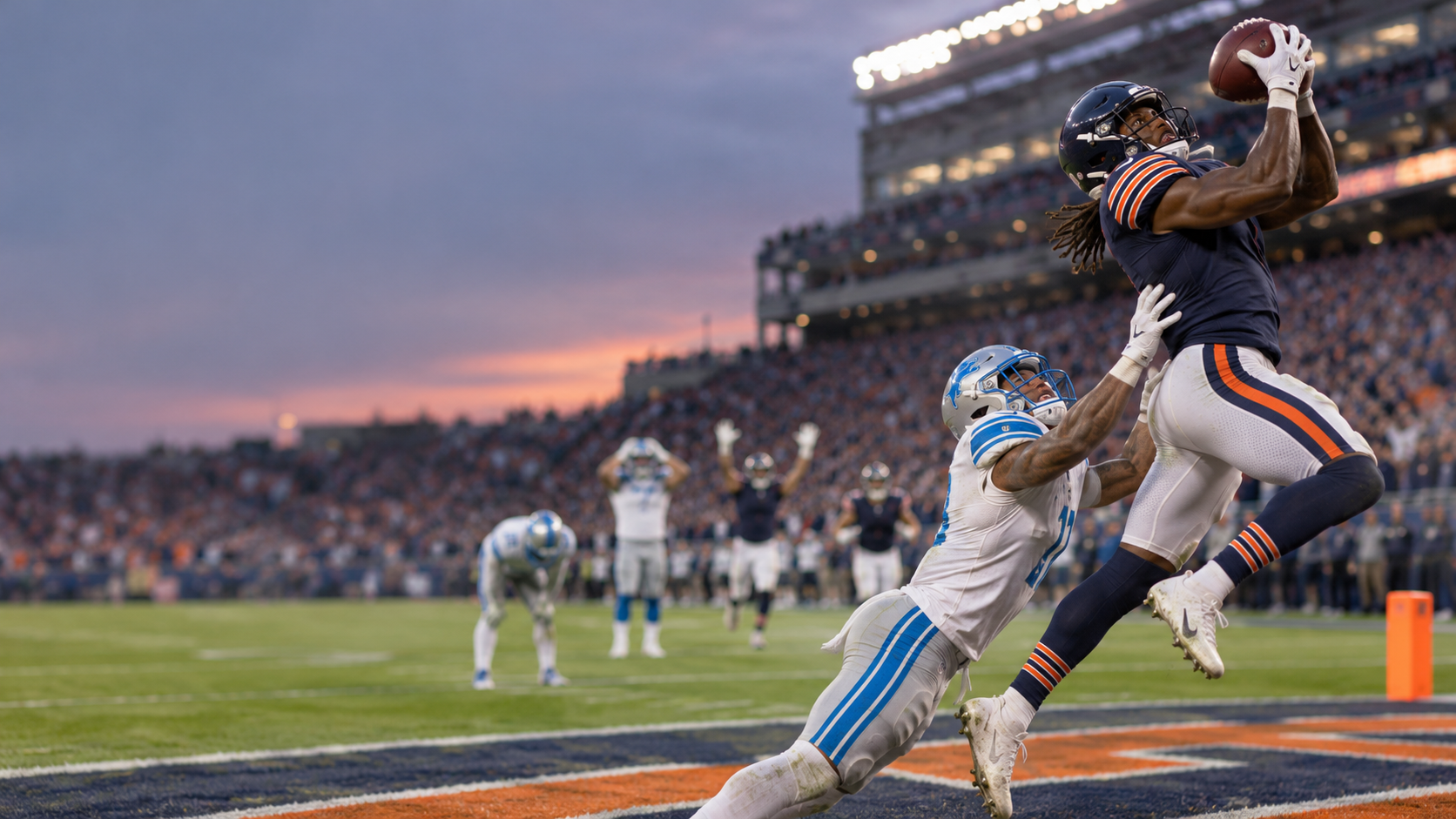 Bears Beat Lions on Reported Late Odunze Touchdown
-
 Eagles vs. Cowboys: Live Updates and Where to Watch
-
 Arkansas, Pitino-Louisville, Baylor-Gonzaga Preview
-
 Michigan RB's Career Game vs Packers: What's Verified
-
 Week 12 Fantasy Football QB, TE, DEF and K Rankings
-
 The Steelers’ Surreal Day Around Aaron Rodgers’ Interview
-
 What Every NFL Team Should Be Thankful for in 2026
-
 Aaron Rodgers Steelers Release: What We Know
-
 Brock Purdy Injury Update: Status vs. Seahawks
-
 LSU Expulsion Vote Ruling Remains Unverified
-
 Murray Powers Nebraska to Reported Big Ten Title
-
 Rams vs. Packers Week 12 Highlights: Corum, Forbes Shine